
NuclearPowerFacts
Nuclear power is gaining attention worldwide for its proven reliability, low operating cost, long life and environmental benefits. The following facts demonstrate the benefits of nuclear power as well as other benefits that are perhaps less well known.
FACT 1: Nuclear Power is a competitive source of base load electricity.
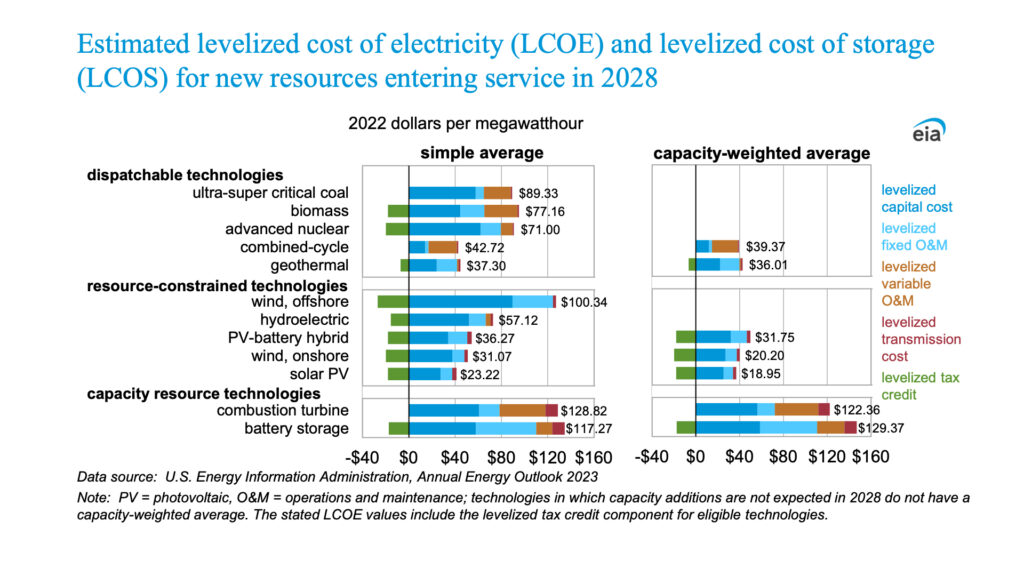
Nuclear Power is a competitive source of base load electricity, with high initial capital costs and low production costs during its 60 to 80 year lifetime. The initial capital costs are high due to the intrinsic safety and security built into the plant design. However, the low fuel and operation costs balance this initial cost and lead to a very competitive and predictable overall cost.
As shown to the right, nuclear power has the lowest production cost of any thermal base load generation option. Production costs are comprised of fuel and operations and maintenance costs. Since 2001, nuclear power plant costs have consistently been below the cost of its nearest competitor-coal-and far less than other available base load options. In 2013, nuclear production costs were 2.3 cents per kilowatt-hour. Moreover, the production costs of nuclear-electrical generation are the most stable and provide desirable predictability to consumers.
FACT 2: Nuclear power is safe and secure, and its operations protective of public health and safety.
The following statement from the Nuclear Regulatory Commission-the federal regulatory entity that oversees the safety of the nuclear industry- reflects the reality about the safety of nucler power.
“Since commercial nuclear power plants began operating in the United States, there have been no physical injuries or fatalities from exposure to radiation from the plants among members of the U.S. public. Even the country’s worst nuclear power plant accident at Three Mile Island resulted in no identifiable health impacts.”
U.S. Nuclear Regulatory Commission (January 2009)
In fact, the U.S. nuclear industry has accumulated almost 3,400 reactor years of operation since the first plant started up in 1957 without serious injury or death to a single member of the public. The nuclear industry is one of the safest industries in the world.
On October 17, 2007, while testifying before the Interim Public Utilities and Technology Committee of the Utah State Legislature, Dr. Nils Diaz, a past Chairman of the Nuclear Regulatory Commission and current Chief Strategic Officer of Blue Castle Holdings, answered a question concerning the safety of U.S. commercial nuclear power by stating “There has never been in the United States of America, never, including Three Mile Island, a release that has posed a hazard to the population of the United States.”
It is a matter of public record that the safety and security of nuclear power plants is recognized as the best of the critical industry infrastructure. Furthermore, the environmental record of nuclear power plants, with essentially zero emissions and solid particle releases, is established as among the most environmentally benign electrical generation suppliers.
FACT 3: Nuclear power plants produce very small volumes of spent fuel. The spent fuel is actually partially used and contains significant amounts of usable energy and a small amount of radioactive waste.
Spent fuel is only waste if it is not recycled or processed after removal from a reactor. Used or spent fuel is actually fissile fuel that contains important energy and industrial materials, as well as non-usable residues. Used reactor fuel is still very valuable; it has about 95% of its initial energy that can be reprocessed or recycled to generate more electricity in the future. For this very reason, it makes sense to utilize used fuel in a manner that will benefit the nation and protect public health and safety. Exercising available options for intermediate term storage, utilizing the used fuel and permanently storing the radioactive residues are prudent to the nation’s energy future and environmental stewardship.
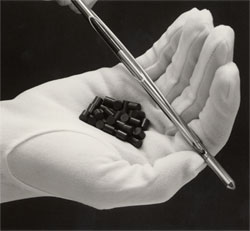
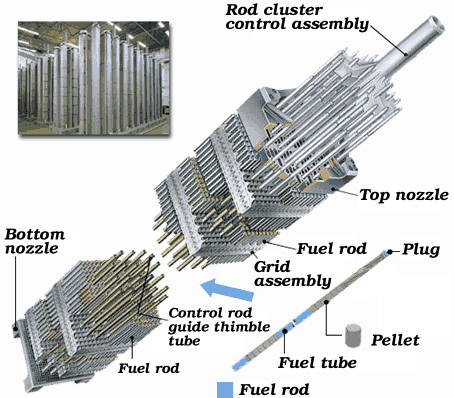
The used fuel is contained in small ceramic pellets, inside a sealed metallic tube. The metallic tubes or rods containing the fuel pellets are then combined with other tubes to create the fuel assembly.
For every reactor, the used fuel is concentrated in a small volume of very high density material. All the used nuclear fuel produced by the U.S. nuclear energy industry in nearly 50 years-if stacked end to end-would cover an area the size of a football field to a depth of less than 10 yards (Source: Nuclear Energy Institute). For a two unit nuclear power station, the spent fuel generated from 60 years of operations, would be safely stored in dry casks on a 1 ½ acre land area, on or off the plant site.
Used nuclear fuel is initially stored in wet storage (spent fuel pools) within the reactor building and later in dry cask storage on nuclear plant sites. After 60 to 80 years of operation, the spent fuel would be transported to be reprocessed or stored at an off-site repository facility. The transportation safety record of the industry is excellent. Past shipments of spent fuel in secured casks have covered 1.7 million miles with no injuries, fatalities or environmental damage.
FACT 4: Reprocessing and/or recycling results in enhanced safety for the safe disposal of remaining waste and utilization of usable fissionable materials.
In 1977 President Carter elected to prohibit recycling in the U.S. as an example of a non-proliferation initiative. The policy was driven by the potential for plutonium from spent fuel to be diverted by non-weapon states for military purposes. Nevertheless, this did not stop other nuclear weapon countries from engaging in the reprocessing of spent fuel, such as Great Britain, France, Germany, Russia and the non-weapon state of Japan. Countries that have nuclear weapons programs have obtained plutonium from their own weapon production from “research” reactors, not from commercial power reactors. The only other manner to obtain nuclear weapons grade material is by enriching uranium to a very high concentration, a difficult and expensive undertaking. As mentioned, Great Britain, France, Japan, Russia and Germany are all recycling a portion of their spent nuclear fuel. No nuclear weapons have been produced through diversion of plutonium from these countries’ reprocessing or shipping facilities.
The current primary deterrent to commercial fuel reprocessing in developing countries with nuclear power programs is economics, since it can be done with adequate international safeguards. There is a strong global incentive to maintain the peaceful uses of atomic energy separate from the potential military uses. Presently, signing the International Non-Proliferation Treaty (NPT) and its strong enhancement via the Additional Protocol are deemed adequate to prevent the spread of nuclear weapons, and especially so for countries that legitimately want to employ nuclear-electrical generation. Presently, 189 states are party to the NPT. Countries that have obtained nuclear weapons since the NPT (1970) have either never signed the treaty (India, Pakistan) or withdrawn from the treaty (North Korea in 2003). Iran has been found to be in non-compliance with its NPT obligations, as it continues to try to enrich uranium using centrifuges without full safeguards.
In fact, nuclear power plants in the U.S. have played an important role in limiting the material available for weapons. A partnership between the United States and Russia has been formed and the U.S. has used down blended enriched, weapons grade uranium from Russia to fuel the U.S. nuclear reactors. About 500 metric tons of highly enriched uranium is no longer available to be used in nuclear weapons because it is being used to produce electricity. Furthermore, the U.S. – Russia led Global Nuclear Threat Initiative is bringing together many nations to support both nuclear power and non-proliferation initiatives.
FACT 5: Utah and the Western region would benefit significantly from nuclear power.
Utah and the western region have significant need for new electricity resources. Utah is one of the primary areas that would benefit from new base load nuclear electrical generation. Because Utah has the closest service area to the proposed plant, it would not incur the cost of long distance transmission, and therefore, load serving electric utilities in the State would have a a cost advantage participating in the Blue Castle project.
The National Electric Reliability Council (NERC) – the organization responsible for assuring the reliability of the nation’s electric system – forecasts that the region comprising Utah will have the third fastest growing demand for electricity in the U.S. at 1.63% per year. Overall demand for electric power in the western U.S. is growing faster than eight of the nine U.S. NERC regions. PacifiCorp, one of the largest electric utilities in the U.S., serving most of Utah and parts of Oregon, Washington, California, Idaho and Wyoming, projects peak load growth to be about 1% per year for the next ten years in their latest 2015 “Integrated Resource Plan.” Given PacifiCorp’s existing resource base of power plants, power purchases, interruptible power contracts and demand side management (DSM) for the eastern region, PacifiCorp’s east service area (comprising Rocky Mountain Power), planning reserve margin (13%) has already been breached and by year 2024 the east service area will require an additional 2,200 megawatts of capacity to meet peak load growth, rising to nearly 5,600 megawatts in 2034 (more below).
Additional pressure for new electric resources in the west is materializing because of coal plant closures and essentially no new coal plant construction. The EPA’s June 2014 “Clean Power Program” which has the aim of reducing carbon emissions 30% below the 2005 emissions by the year 2030, will insure that no new coal plants will be built in the U.S. Additionally, both state and federal regional air quality statutes are already affecting existing coal power plant operations resulting in the 2005 closure of the 1,500 megawatt Mohave Power Station in Nevada. The EPA has also targeted the 2,040 megawatt Four Corners Power Plant in New Mexico to either improve emissions or shutdown. The 2,280 megawatt Navajo Generation Station in Arizona will likely be next. Approximately half of PacifiCorp’s base of 6,500 megawatt coal generating plants could be closed by year 2030 under some of the regional air quality regulation scenarios and nearly all of these plants will require expensive modifications in the near term to remain in operation. All of this has a disproportionate effect on power generation in the western U.S. because of its historically heavy dependence on coal.
The value proposition of new nuclear can be represented by comparing projected electricity costs from the most likely new base load alternatives-natural gas. A new coal resource is not included in this comparison because of the low probability that such a project could successfully be permitted in the foreseeable future.
PacifiCorp has projected the range of costs for electricity produced with natural gas to be anywhere from slightly higher than nuclear power to as much as double the cost of nuclear electricity when gas is used in plants that are not base loaded. Natural gas is the only dual use fuel used by electric generators and presents business risks that are extremely difficult to contain and manage. In the early 2000s, gas market volatility caused the collapse of the merchant natural gas generating industry. However, the lower initial capital cost and short construction time makes natural gas a continuing option for some utilities, especially with the current low marketplace cost of gas. The importance of fuel diversification and price predictability for a region like Utah should not be underestimated, making nuclear power a natural option for inclusion in the state energy portfolio.
Nuclear power on the other hand presents virtually no volatility issues to generators. The cost of nuclear fuel is less than 12% of the total cost of nuclear generation (versus 80% for natural gas). Once a nuclear plant begins commercial operation there are almost no resource risks to manage and the cost of nuclear electricity is highly stable and predictable.
Even though it will require five years to license and another five to seven years to build a new nuclear facility, the benefits over its 60 year lifetime will improve the base loaded, low cost electricity supply to Utah and some of its neighbors.